
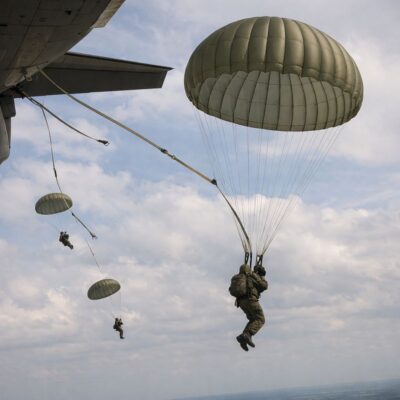
 In the high-stakes world of military airborne operations, reliability is everything. From training jumps to tactical insertions, the static line parachute remains a foundational tool across global armed forces. Designed for rapid deployment, low-altitude drops, and coordinated mass jumps, these parachutes play a critical role in troop movement and preparedness.
At Aerodyne, we manufacture static line parachute systems tailored for military and defense clients who demand mission-ready performance. In this guide, we’ll break down how static line parachutes work, why they’re still widely used, and how Aerodyne delivers uncompromising quality through every component of our systems.
What Is a Static Line Parachute?
A static line parachute is a non-freefall parachute that deploys automatically when the jumper exits the aircraft. A line attached from the parachute to the inside of the aircraft pulls the deployment bag free, allowing the canopy to inflate without any manual action from the jumper.
This system enables:
Rapid and automatic deployment
Low-altitude drops (typically between 800 and 1,500 feet)
Mass troop deployment in minimal airspace
How Does a Static Line Parachute Work?
Here’s a step-by-step breakdown of the deployment process:
1. Aircraft Exit
As the jumper exits the aircraft, the static line remains connected to a cable or anchor point inside the aircraft.
2. Deployment Initiation
The static line pulls the deployment bag from the container, initiating canopy inflation.
3. Canopy Inflation
Within seconds, the main canopy inflates fully, decelerating the jumper for a safe descent.
4. Descent and Landing
The jumper descends under a round or steerable canopy, typically landing in a designated drop zone. Some systems (like Aerodyne’s MC1 series) allow basic directional control.
Why Static Line Parachutes Are Used in Military Operations
Despite modern advances in freefall and high-altitude systems, static line parachutes remain essential for several mission types:
Mass Troop Deployment
Ideal for large-scale airborne units—dozens of troops can exit a single aircraft within seconds.
Low-Altitude Efficiency
The automatic deployment minimizes the margin of error during low-altitude drops.
Training & Standardization
Static line jumps are the standard entry point for airborne training due to their simplicity and safety profile.
Tactical Versatility
Used in both training and real-world combat missions, especially where speed and coordination are critical.
Aerodyne’s Static Line Parachute Systems
Aerodyne supplies static line parachute systems designed for reliability, modular compatibility, and mission flexibility. Each component is built to military standards and tested under rigorous conditions.
MC1-1B & MC1-1C (Steerable Canopies)
35-foot parabolic canopy
Control toggles for basic steering
Used in tactical operations requiring obstacle avoidance
T10 Parachute System
Non-steerable round canopy
Deployed for standard mass-troop insertions and airborne training
Made with MIL-C-7020 Type I ripstop nylon
These systems are field-proven and supported by our full range of military parachute accessories, including breakaway rucksacks, harnesses, and oxygen systems for high-altitude variations.
Related: Non-Steerable Parachute Systems: Reliable and Time-Tested Solutions
Key Advantages of Aerodyne’s Static Line Systems
Built-In Deployment Safety
Static lines are reinforced with high-tensile strength and tested under dynamic load conditions to avoid failure mid-jump.
Modular Integration
Compatible with Aerodyne accessories like helmet-mounted oxygen systems and tactical gear vests.
Steerable Options
Our MC1 variants offer directional control—a strategic advantage over non-steerable systems in tactical drops.
Learn more about our range of Military Parachute Systems
Deployment Scenarios for Static Line Systems
Aerodyne static line systems are used in:
Airborne training programs worldwide
Special operations requiring low-profile insertions
Joint-force deployments under NATO protocols
Disaster response efforts, where terrain prevents aircraft landing
From desert warfare to jungle insertions, static line systems remain the most adaptable and accessible parachute configuration in military history.
Best Practices for Jump Teams and Instructors
Always Coordinate with Jumpmasters
Static line systems must be properly rigged and configured to avoid entanglement or premature deployment.
Inspect Deployment Bags and Lines
Wear, cuts, or knots in static lines are a critical safety risk—Aerodyne recommends pre-jump and post-jump inspections.
Train With Full Gear Loadouts
Static line parachutes react differently under full kit conditions. Ensure your loadout replicates mission weight.
Pro Tip: Read our Tips for Extending the Life of Your Parachute for long-term maintenance strategies.
Conclusion: Reliability Starts with Static Line Simplicity
Static line parachutes have remained relevant for a reason: they’re fast, reliable, and mission-tested. Whether training new recruits or executing precision low-altitude insertions, Aerodyne’s static line systems provide the confidence and consistency military professionals demand.
Our MC1 and T10 models are engineered to deliver on every jump—so you can focus on the mission ahead.
Contact us today to find out more about our static line parachute systems or to request a custom quote.
