
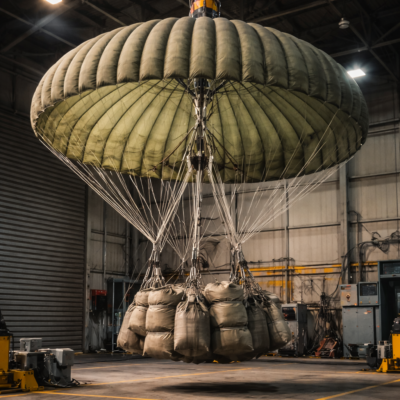
 In modern defense procurement, compliance is not optional — it is foundational. When evaluating suppliers, military agencies and defense contractors must ensure that parachute systems meet strict regulatory standards. Among the most critical are MIL-STD parachute requirements, which define how military parachutes must perform under operational conditions.
For procurement officers, logistics commanders, and defense engineers, understanding these requirements is essential before issuing tenders or awarding contracts.
At Aerodyne, our parachute systems are engineered and tested to align with applicable MIL-STD and NATO standards, ensuring reliability in real-world deployment scenarios.
What Are MIL-STD Parachute Requirements?
MIL-STD (Military Standard) refers to a set of standards developed by the U.S. Department of Defense to ensure uniform engineering, performance, testing, and manufacturing criteria across defense equipment.
For parachute systems, MIL-STD requirements typically govern:
Structural load capacity
Material durability
Deployment reliability
Environmental resistance
Inspection and maintenance protocols
These standards ensure that parachutes function safely during:
Static line deployments
Tactical low-altitude insertions
High-altitude operations
Cargo drop missions
Key MIL-STD Standards Relevant to Military Parachutes
While multiple standards may apply depending on configuration, several compliance categories are critical in parachute manufacturing.
Load Testing & Structural Integrity
Military parachutes must withstand specified dynamic and static load thresholds. Testing includes:
Maximum suspended weight capacity
Shock absorption during canopy opening
Reinforcement testing of suspension lines
Stitch and seam strength verification
Aerodyne systems such as the T10 series and MC1-1C are engineered to meet stringent load performance requirements for both personnel and gear integration.
Related:
Military Parachute Systems – https://aerodyne-mps.com/2024/11/07/military-parachute-systems-precision-and-reliability-with-aerodyne/
Environmental & Material Testing
MIL-STD parachute requirements include environmental exposure testing to ensure operational reliability in:
Extreme heat
Sub-zero conditions
High humidity
UV exposure
Salt corrosion environments
Aerodyne utilizes MIL-C-7020 Type I 1.1 oz ripstop nylon, known for durability and environmental resistance.
Related:
Different Types of Nylon Ripstop Fabric – https://aerodyne-mps.com/2023/09/12/different-types-of-nylon-ripstop-fabric-singapore/
Deployment Reliability Standards
One of the most critical compliance areas is deployment reliability. Testing evaluates:
Deployment sequence timing
Static line extraction integrity
Canopy inflation symmetry
Malfunction rate thresholds
Static line systems must deploy within strict timing windows to ensure safe low-altitude descent.
Related:
Non-Steerable Parachute Systems – https://aerodyne-mps.com/2025/02/06/non-steerable-parachute-systems-reliable-and-time-tested-solutions/
NATO STANAG & International Compatibility
In addition to MIL-STD requirements, many international defense agencies require compliance with NATO STANAG 2338, which governs parachute interoperability and testing protocols.
For global procurement, this ensures:
Cross-compatibility among allied forces
Uniform testing methodology
Consistent load performance benchmarks
Aerodyne systems are fielded in over 30 countries and align with applicable NATO compatibility expectations.
Military Parachute Testing & Certification Process
Before entering operational service, compliant parachute systems undergo:
Prototype evaluation
Drop testing at varied altitudes
Load stress analysis
Environmental simulation
Documentation review and traceability audits
Testing includes both personnel and cargo configurations.
In high-altitude capable systems, oxygen integration and thermal compatibility are also evaluated.
Related:
Airborne Insertion Techniques – https://aerodyne-mps.com/2025/04/03/airborne-insertion-techniques-mastering-modern-military-deployment-with-aerodyne/
Why Compliance Matters in Defense Procurement
For procurement teams, MIL-STD compliance ensures:
Reduced liability risk
Standardized inspection protocols
Lower long-term maintenance costs
Operational reliability in combat environments
Non-compliant systems can lead to:
Deployment failures
Equipment loss
Personnel injury
Contract termination
In 2026, as global defense budgets increase, compliance documentation has become one of the first checkpoints in supplier evaluation.
How Aerodyne Meets MIL-STD Requirements
Aerodyne parachute systems are engineered with compliance in mind from design through production.
We provide:
Documented load testing data
Material traceability
Modular system integration
Compatibility with military harnesses and oxygen systems
Support for procurement documentation review
From static line systems to advanced tactical configurations, our parachutes are built for performance, durability, and operational accountability.
Conclusion: Compliance Is the Foundation of Operational Readiness
Understanding MIL-STD parachute requirements is essential for defense agencies seeking reliable airborne systems. Compliance is more than a certification — it is a guarantee of performance under the most demanding conditions.
Aerodyne remains committed to delivering parachute systems that align with strict military standards while supporting modern tactical demands.
For procurement discussions, documentation requests, or system specifications:
Contact us today to find out more
https://aerodyne-mps.com/contact/
