
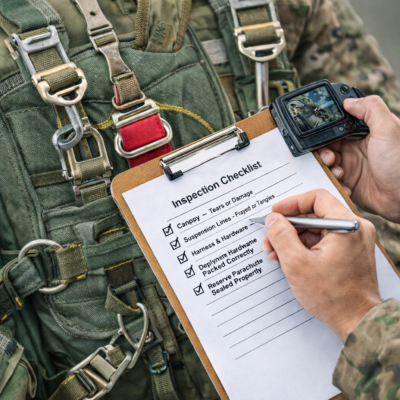
 In military airborne operations, performance begins long before a jump—it starts with inspection. Every successful deployment depends on equipment that has been properly maintained, tested, and verified. That’s why having a structured military parachute inspection checklist is critical for ensuring safety, reliability, and mission success.
At Aerodyne, we design parachute systems built for durability and compliance, but even the most advanced systems require consistent inspection. This guide outlines essential inspection procedures, best practices, and what military units should prioritize in 2026.
Why Parachute Inspection Matters in Military Operations
Parachutes operate under extreme conditions—high altitude, rapid deployment, heavy load stress, and unpredictable environments. Without proper inspection, risks include:
- Deployment failure
- Line entanglement
- Canopy damage
- Load imbalance
- Injury or fatality
A standardized military parachute inspection checklist reduces these risks and ensures every system is mission-ready.
Pre-Jump Parachute Inspection Checklist
Before any airborne operation, a full inspection must be completed. This applies to both static line systems and advanced tactical parachutes.
1. Canopy Inspection
Check for:
- Tears, holes, or abrasions
- Fabric weakening or discoloration
- Stitching integrity
- Signs of UV or moisture damage
Aerodyne parachutes are constructed using MIL-C-7020 ripstop nylon, designed to resist tearing, but visual inspection remains essential.
2. Suspension Lines & Risers
Inspect:
- Fraying or cuts
- Uneven tension
- Twisting or tangling
- Attachment points to canopy and harness
Suspension lines must distribute load evenly—any weakness can lead to instability during descent.
3. Deployment System (Static Line / Pilot Chute)
Check:
- Secure attachment points
- No knots or wear in static line
- Proper packing of deployment bag
- Extraction system functionality
For static line parachutes, this is one of the most critical inspection areas.
Related reading:
https://aerodyne-mps.com/2025/02/06/non-steerable-parachute-systems-reliable-and-time-tested-solutions/
4. Harness & Container System
Verify:
- Strap integrity
- Buckles and fasteners
- Load-bearing stitching
- Proper fit and adjustment
Aerodyne harness systems are designed for modular compatibility, but must always be correctly fitted to the user.
5. Reserve Parachute System
Inspect:
- Proper packing certification
- Deployment handle accessibility
- Container seal integrity
Reserve systems must always be ready for immediate use in emergency situations.
Post-Jump Inspection Checklist
After every jump, parachutes must be inspected again before reuse.
1. Canopy Re-Inspection
Check for:
- New damage from landing
- Dirt, moisture, or debris
- Fabric stress points
2. Line Condition
Ensure:
- No stretching or deformation
- No knots or tangles
- Clean and properly aligned lines
3. Hardware & Connectors
Inspect:
- Metal fittings
- Carabiners
- Quick-release systems
Any deformation or corrosion must be addressed immediately.
Scheduled Maintenance & Inspection Intervals
Military parachutes are not only inspected before and after jumps—they follow strict maintenance schedules.
Typical guidelines include:
- Pre-jump inspection: Before every deployment
- Post-jump inspection: After every use
- Periodic inspection: Based on operational hours or storage duration
- Repacking cycles: At defined intervals
Proper scheduling ensures compliance with MIL-STD parachute requirements and extends system lifespan.
Common Causes of Parachute Failure
Understanding failure points helps improve inspection accuracy.
Most Common Issues:
- Improper packing
- Undetected canopy damage
- Worn suspension lines
- Faulty deployment systems
- Environmental degradation
This is why structured checklists are non-negotiable in military operations.
How Aerodyne Supports Inspection & Maintenance
Aerodyne parachute systems are designed with inspection efficiency in mind. We support military clients with:
- Durable, inspection-friendly materials
- Clear system configurations
- Modular components for easy replacement
- Compatibility with military maintenance protocols
Our systems are engineered to meet MIL-STD and NATO standards, ensuring consistent performance across multiple deployment scenarios.
Best Practices for Military Units
To maintain operational readiness:
Use standardized checklists
Train personnel on inspection procedures
Maintain inspection logs and documentation
Replace worn components immediately
Conduct regular refresher training
Inspection is not just a checklist—it’s a discipline.
Conclusion: Safety Starts Before the Jump
A well-executed military parachute inspection checklist is the foundation of airborne safety. From canopy to harness, every component must be verified to ensure successful deployment.
Aerodyne continues to support military forces worldwide by providing parachute systems built for durability, compliance, and ease of maintenance.
👉 Contact us today to find out more
https://aerodyne-mps.com/contact/
