
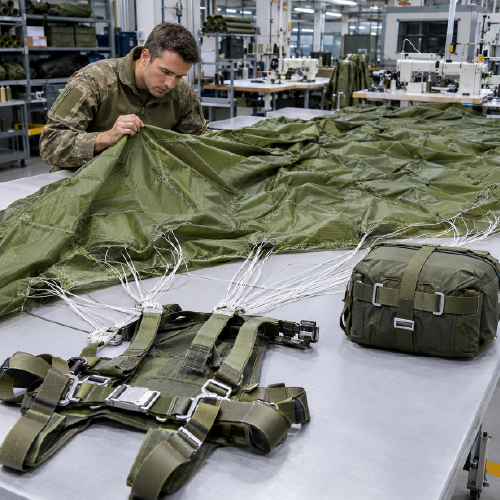
Modern airborne operations place significant demands on both personnel and equipment. Paratroopers may already be carrying weapons, protective equipment, communications systems, mission supplies and additional load-bearing equipment before the parachute system itself is considered.
For this reason, the weight and packed volume of military parachute equipment have become important considerations in the development and procurement of modern airborne systems.
Lightweight military parachutes are not simply about making equipment lighter for convenience. Reducing unnecessary weight and bulk can influence equipment integration, mobility, storage, aircraft operations and the overall load carried by airborne personnel.
The challenge is achieving those benefits while still meeting the performance, durability and safety requirements expected from military parachute equipment.
What Is a Lightweight Military Parachute?
A lightweight military parachute is a parachute system designed to reduce system weight, packed volume or both while still meeting the requirements of its intended airborne application.
This does not necessarily mean radically changing the parachute itself.
Weight reduction can potentially come from several areas, including:
- Canopy materials
- Suspension-line materials
- Webbing
- Harness components
- Containers
- Hardware
- System configuration
- Manufacturing design
The importance of each component depends on the particular parachute system.
Military organisations therefore need to evaluate weight as part of the complete parachute system, rather than considering the canopy in isolation.
Why Does Parachute Weight Matter?
Military personnel rarely operate with a parachute alone.
An airborne soldier may need to carry a combination of personal equipment and mission-specific gear. The total load placed on the individual can therefore become substantial.
Every kilogram allocated to the parachute system contributes to that overall burden.
Reducing unnecessary parachute weight may help improve the way equipment is distributed across the operator and can create additional flexibility when planning airborne equipment configurations.
Weight also affects more than the individual paratrooper.
Military organisations may need to consider:
- Aircraft loading
- Equipment transportation
- Storage
- Logistics
- Handling
- Mission preparation
- Compatibility with additional airborne equipment
These factors make parachute system weight relevant to both operational personnel and defence procurement teams.
What Is Parachute Pack Volume?
Pack volume refers to the amount of physical space a parachute system occupies when packed.
Two parachute systems may perform similar functions while occupying different amounts of space once packed.
Reducing pack volume can potentially make equipment more compact and easier to integrate with other mission equipment.
This is particularly important because airborne personnel need to operate with multiple systems attached to or carried around the body.
A bulky parachute system can affect how other equipment is positioned.
For procurement teams, the question should therefore not only be:
How much does the parachute weigh?
It should also be:
How much space does the complete system occupy when packed?
Weight and pack volume are related but distinct considerations.
Why Canopy Materials Matter
The canopy represents a significant textile component within a parachute system.
Material selection can therefore influence both weight and packed volume.
Modern parachute development increasingly examines whether advanced textile materials can provide the required characteristics while reducing unnecessary mass or bulk.
However, selecting parachute fabric involves more than simply choosing the lightest material available.
Material requirements may include factors such as:
- Strength
- Porosity
- Tear resistance
- Construction suitability
- Consistency
- Durability
- Compatibility with the parachute design
The precise requirements depend on the system and its intended application.
A lighter material is only useful if it remains suitable for the parachute system in which it will be used.
Lighter Does Not Automatically Mean Better
Reducing weight is beneficial only when it does not undermine other critical requirements.
This is an important distinction for military procurement.
A parachute system cannot be assessed according to weight alone.
Military organisations must consider a combination of factors, including:
Weight + performance + durability + reliability + compatibility + operational requirements
A lighter system that cannot meet the required mission profile would offer little practical advantage.
Similarly, reducing material weight without considering system design, deployment characteristics and operational loads could create an inappropriate balance between weight reduction and performance.
This is why lightweight parachute development is fundamentally an engineering optimisation problem rather than simply a material-reduction exercise.
Reducing the Soldier’s Equipment Burden
Military organisations continually evaluate how much equipment personnel must carry.
For airborne units, parachute equipment adds another significant system to an already complex load.
A more efficient parachute configuration may help reduce unnecessary burden while preserving the equipment needed for the mission.
This can be particularly relevant during the period after landing.
Once on the ground, airborne personnel may still need to move rapidly, organise equipment and transition from the airborne phase into ground operations.
Weight reduction therefore has implications beyond the aircraft and the jump itself.
It forms part of the wider challenge of designing equipment around the requirements of the operator.
Parachute Weight and System Integration
Military parachutes operate as part of a broader airborne equipment environment.
Depending on the mission, this can include:
- Reserve parachutes
- Harness systems
- Equipment bags
- Load carriage equipment
- Protective equipment
- Communications equipment
- Weapons
- Mission-specific equipment
All of these components compete for space and carrying capacity.
This makes system integration increasingly important.
Reducing the weight or packed volume of one component can potentially create greater flexibility elsewhere within the operator’s equipment configuration.
However, individual components should never be optimised without considering the complete system.
Why Defence Organisations Are Investigating Lightweight Materials
The interest in lightweight parachute materials is not theoretical.
Modern defence programmes continue to investigate how advanced canopy materials could reduce both parachute weight and packed volume.
This reflects a broader trend within military equipment development: achieving required capability while reducing unnecessary burden wherever technically feasible.
For parachute manufacturers, this places greater emphasis on the relationship between material engineering and system design.
New materials must still work within the aerodynamic, structural and operational requirements of the parachute.
This is why material innovation and parachute engineering need to develop together.
What Should Defence Procurement Teams Consider?
When evaluating military parachute systems, procurement teams should avoid focusing on a single specification.
A lightweight system should be evaluated within the context of the complete operational requirement.
Useful questions include:
- What is the complete system weight?
- What is the packed volume?
- What operational load is the system designed to accommodate?
- Which materials are used within the system?
- How do those materials contribute to weight reduction?
- What durability requirements apply?
- What deployment method is required?
- How does the parachute integrate with other airborne equipment?
- What inspection and maintenance requirements apply?
- Which standards or specifications govern the procurement?
- What evidence supports the system’s stated performance?
These questions allow procurement teams to distinguish meaningful system optimisation from simple marketing claims about lightweight construction.
The Relationship Between Design and Weight Reduction
Weight reduction should ideally begin at the design stage.
Changing a single material may reduce mass, but meaningful optimisation requires manufacturers to examine how the complete parachute system operates.
This can include the relationship between:
Canopy → Suspension Lines → Harness → Container → Hardware → Deployment Components
Each element contributes to overall system weight and functionality.
Designers therefore need to consider where weight can realistically be reduced without compromising the requirements of the completed system.
This is where parachute design, material selection and manufacturing become closely interconnected.
Lightweight Military Parachutes and Future Airborne Systems
The drive towards lighter military equipment is likely to remain relevant as airborne forces carry increasingly sophisticated mission systems.
Communications technology, protective equipment, sensors and other mission-critical equipment all add weight.
Parachute systems therefore cannot be evaluated independently from the wider equipment environment.
Future military parachute development may increasingly focus on achieving a better balance between:
- Reduced weight
- Reduced pack volume
- Required performance
- Durability
- Equipment compatibility
- Operational flexibility
For defence organisations, the objective is not simply to acquire the lightest parachute available.
The objective is to identify the system that provides the appropriate balance for the mission.
Aerodyne and Military Parachute Systems
Aerodyne designs and manufactures parachuting equipment for military applications.
The development of military parachute systems requires careful consideration of design, materials, manufacturing and the operational requirements of the end user.
Weight and pack volume form part of that broader system-level evaluation.
For defence organisations assessing parachuting equipment, understanding these relationships can help procurement teams ask more informed questions and compare systems according to their complete operational requirements rather than individual specifications alone.
Frequently Asked Questions
What is a lightweight military parachute?
A lightweight military parachute is a parachute system designed to reduce overall equipment weight, packed volume or both while still meeting the requirements of its intended military airborne application.
Why does military parachute weight matter?
Parachute weight contributes to the total equipment load carried by airborne personnel and can also affect transportation, logistics, equipment integration and mission planning.
What is parachute pack volume?
Pack volume describes how much physical space the parachute occupies when packed. A lower pack volume can help create a more compact equipment configuration.
Can lighter canopy fabric reduce parachute weight?
Potentially. Canopy material can influence system weight and packed volume, but any material must remain appropriate for the design and performance requirements of the parachute.
Does a lighter military parachute mean it is less durable?
Not necessarily. Weight alone does not determine durability. Material properties, system design, manufacturing quality and operational requirements all need to be evaluated together.
What should defence buyers look for in a lightweight parachute system?
Buyers should evaluate complete system weight, packed volume, operational requirements, material specifications, compatibility, durability, documentation and verified performance rather than considering weight alone.
Finding the Right Balance
The development of lightweight military parachutes is ultimately about optimisation.
Reducing unnecessary weight and packed volume can offer meaningful benefits, but those improvements must exist alongside the performance, durability, reliability and operational requirements expected from military airborne equipment.
For defence procurement teams, the strongest approach is therefore to evaluate the complete system.
Parachute weight, materials, pack volume, deployment requirements and equipment integration should all form part of the decision.
Aerodyne designs and manufactures parachuting equipment for military applications, with system requirements considered as part of the broader design and manufacturing process.
For more information about Aerodyne’s military parachute systems, contact us today to find out more.
