
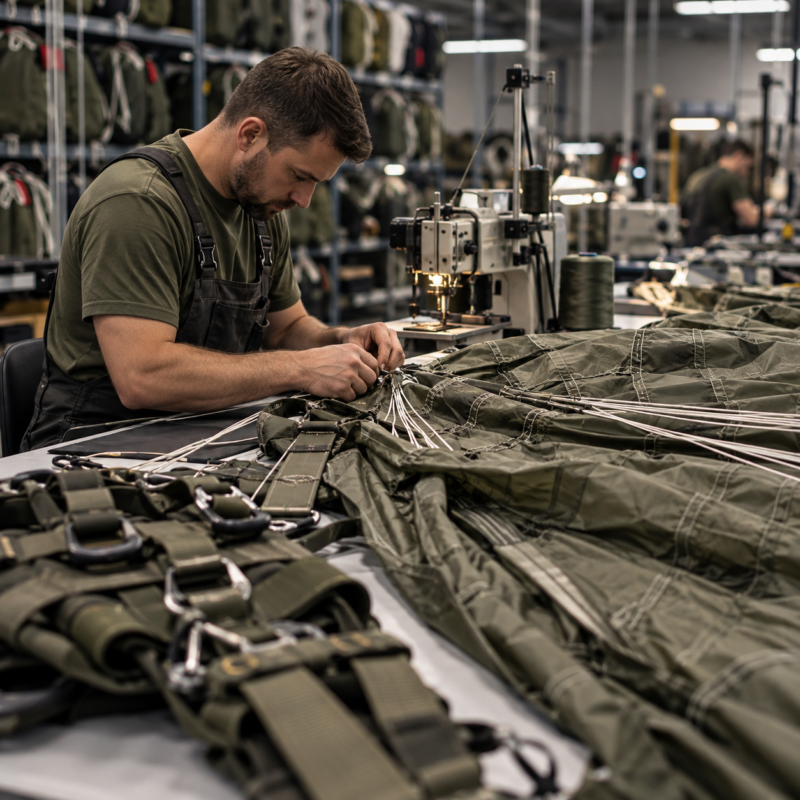
Military parachutes are specialised systems designed for environments where consistency, reliability and correct performance are critical. Behind every completed system is a manufacturing process that extends far beyond simply cutting fabric and stitching a canopy together.
Military parachute manufacturing brings together design, material selection, component production, assembly, inspection, testing and quality control. Each stage contributes to the finished parachute system and must be managed according to the requirements of the particular design and application.
For military organisations and defence procurement teams, understanding how parachutes are manufactured can therefore be just as important as understanding their operational specifications.
What Is Involved in Military Parachute Manufacturing?
Military parachute manufacturing is the process of transforming an approved parachute design and its specified materials and components into a complete parachute system.
The exact manufacturing process varies according to the type of parachute being produced. However, it can involve several interconnected stages:
- Design and engineering
- Material selection and verification
- Pattern preparation and cutting
- Component manufacturing
- Sewing and assembly
- Hardware and system integration
- In-process inspection
- Final quality control
- Testing and verification
Documentation
These stages cannot be considered independently.
A parachute is an integrated system. The canopy, suspension lines, webbing, harness, container and associated components must ultimately function together according to the requirements of the particular system.
Military Parachute Manufacturing Begins With Design
Before manufacturing starts, there needs to be a clearly defined parachute design.
Different military airborne applications create different requirements. A parachute intended for one type of deployment cannot automatically be assumed to meet the requirements of another.
Design considerations may include factors such as intended deployment method, operational environment, system configuration, required performance and compatibility between components.
This makes engineering an important starting point.
Manufacturing quality cannot compensate for a system that was not appropriately designed for its intended application. Likewise, a well-engineered parachute still needs to be manufactured accurately and consistently if the finished product is to conform to its design requirements.
The relationship between design and manufacturing is therefore fundamental.
Why Material Selection Matters
Textile materials form a major part of parachute construction, but not every parachute uses exactly the same material specification.
Depending on the system, manufacturers may work with specified canopy fabrics, suspension-line materials, webbing and other textile components selected for the requirements of that design.
Material consistency matters because variations can influence the characteristics of the finished component.
For military procurement in particular, material requirements may be defined by the applicable design, specification or contract. Verification of parachute textile materials can itself be subject to formal testing requirements.
This is why responsible military parachute manufacturing requires more than selecting a material because it appears strong or lightweight.
The material must be appropriate for the system being produced.
From Fabric to Parachute Components
Once the appropriate materials and specifications have been established, manufacturing moves into component production.
Patterns need to be accurately followed, materials need to be correctly cut, and individual sections need to be assembled according to the requirements of the design.
Precision becomes particularly important at this stage.
A parachute canopy, for example, is constructed from multiple fabric sections that must form the intended finished geometry. Suspension lines and load-bearing components must also be incorporated according to the system design.
The same principle applies throughout the parachute system: individual components ultimately need to work as part of a complete assembly.
Manufacturing therefore requires repeatable processes rather than ad hoc production.
Why Stitching and Assembly Require Precision
Stitching is one of the most visible elements of parachute manufacturing, but its importance extends beyond appearance.
Seams and stitched assemblies form part of the structural construction of textile parachute components. Manufacturing procedures must therefore control how components are assembled and ensure that the finished product conforms to the applicable requirements.
Assembly also brings together the different parts of the system.
Depending on the parachute, these may include the canopy, suspension lines, risers, harness, container, deployment components and associated hardware.
Incorrect assembly can compromise an otherwise correctly manufactured component.
For this reason, military parachute manufacturing needs quality control throughout production rather than relying solely on an inspection once the entire system has been completed.
What Is Quality Control in Military Parachute Manufacturing?
Quality control is the structured process used to identify whether materials, components and completed products meet their applicable requirements.
In military parachute production, inspection can take place at multiple stages.
This may include checking:
- Materials before or during production
- Cutting accuracy
- Component construction
- Stitching and seams
- Assembly
- Hardware and attachment points
- Finished components
- Completed parachute systems
This staged approach is important because manufacturing quality is easier to control when potential problems are identified during production rather than only after a complete system has been assembled.
Quality control therefore becomes part of the manufacturing process itself.
How Are Military Parachutes Tested?
There is no single test that applies identically to every military parachute.
Testing requirements depend on the parachute system, applicable specifications, procurement requirements and the aspect of performance or construction being verified.
Testing may occur at different levels.
Materials can be subject to verification before they become part of a finished system. Components can require inspection during manufacture. Completed systems may also be evaluated against the requirements applicable to their design.
This distinction is important for procurement teams.
Asking whether a parachute is “tested” is only the beginning. A more useful question is:
What testing and verification requirements apply to this particular parachute system?
That allows buyers to evaluate the system against its intended application and procurement requirements rather than relying on a generic quality claim.
Why Traceability and Documentation Matter
Military procurement requires more than a physical product.
Technical information and manufacturing documentation can form an important part of demonstrating that equipment corresponds with the required specification.
Depending on the procurement programme, documentation requirements may relate to materials, inspections, testing, configuration or other aspects of the manufacturing process.
This creates a chain between what was specified, what was manufactured and what was ultimately supplied.
For procurement teams, documentation can therefore support technical evaluation and accountability throughout the acquisition process.
Requirements will vary by contract, system and purchasing authority, so documentation expectations should be established during procurement rather than assumed afterwards.
Military Standards and Parachute Manufacturing
Military parachute procurement can involve formal standards and specifications covering particular materials, manufacturing processes, inspections or tests.
However, there is an important distinction:
There is no single universal military standard that automatically defines every requirement for every parachute system.
Applicable requirements depend on the product, procurement authority, contract and intended application.
Procurement teams should therefore identify which standards and specifications apply to the system being acquired and confirm how those requirements are addressed.
This is more meaningful than relying on broad statements such as “military grade” without understanding the underlying technical requirements.
What Should Defence Procurement Teams Look for in a Military Parachute Manufacturer?
Selecting a manufacturer should involve more than comparing headline product specifications.
Procurement teams can consider questions such as:
- Does the manufacturer design and manufacture the required type of parachute equipment?
- Is the proposed system appropriate for the intended airborne application?
- What materials and components are specified?
- What quality-control processes apply during manufacturing?
- What inspection requirements apply?
- How is the finished system verified?
- What technical documentation is available?
- Which standards or specifications apply to the procurement?
- How are system components intended to work together?
- What support is available before and after acquisition?
These questions help procurement teams assess the complete manufacturing and supply proposition rather than evaluating a parachute as an isolated product.
Aerodyne and Military Parachute Manufacturing
Aerodyne is a parachute designer and manufacturer producing parachuting equipment for military applications.
The company builds parachute systems and components, including main and reserve parachutes and parachute-container systems. Aerodyne’s approach also allows compatible components to be supplied as part of an integrated equipment solution.
Manufacturing military parachutes requires the relationship between design, materials, construction, assembly and quality assurance to remain clear throughout production.
For defence organisations evaluating parachuting equipment, understanding these relationships can help procurement teams ask better technical questions and select systems suited to their requirements.
Frequently Asked Questions About Military Parachute Manufacturing
What materials are used to manufacture military parachutes?
Materials depend on the specific parachute design. Military parachute systems can incorporate specialised canopy fabrics, suspension-line materials, webbing, hardware and other components selected according to the requirements of the system.
Are military parachutes handmade?
Parachute manufacturing combines specialised production processes with skilled human assembly and inspection. Textile components require accurate cutting, sewing and assembly according to the requirements of the particular design.
How is quality controlled during parachute manufacturing?
Quality control can occur throughout production, including material verification, in-process inspections, component checks, assembly inspections and final product verification according to applicable requirements.
Do all military parachutes follow the same standards?
No. Applicable standards and specifications depend on the parachute system, procurement authority, contract and intended application.
Why should procurement teams investigate the manufacturing process?
Understanding manufacturing and quality-control processes helps procurement teams evaluate whether the proposed equipment, documentation and verification requirements align with their operational and contractual needs.
Quality Begins Before the Finished Parachute
Military parachute manufacturing is not one isolated production step.
It is a controlled progression from design and material selection through component manufacturing, assembly, inspection and verification.
For defence procurement teams, this means quality should be evaluated throughout the system rather than judged only by the appearance or headline specifications of the finished parachute.
Aerodyne designs and manufactures parachuting equipment for military applications, bringing system design and manufacturing together within its parachute offering.
For more information about Aerodyne’s military parachute systems and manufacturing capabilities, contact us today to find out more.
